<概要/Course Content Summary>
This 15 weeks academic course introduces the culture of Japanese gardens to Japanese and foreign students of Doshisha University. Especially,it focuses on the main philosophical values,styles, aesthetics,and landscape design principles through history. By doing specific activities, writing assignments and oral presentations students increase their knowledge and the meaning of what has been learnt from their interactions and shared experiences. Comparisons with historical gardens examples in other cultures are planned to strengthen final debates and discussions as well as to help the formation of group-research projects for final evaluation. The course is structured in three sessions, each one of five weeks. The first two sessions (10 weeks) are defined as 'Knowledge-based Learning'. Through the themes studied, an understanding of cultural ecology,religion, aesthetics, and landscape art fundamentals are pursued to expand environmental consciousness and a sensitive attitude toward nature. Each class ends with a 10 minutes video documentary related to the theme presented to deepen knowledge. The last session (5 weeks) focuses on the 'Practicum' for experiential and skill-based learning where student’s participation and contribution are expected. In this session the students are not only introduced to the development of techniques for research capability and information management, but to enhance communicative skills and cross cultural competence. For this course an enthusiastic participation and positive attitude are required, where learning takes place in an interactive and culturally diverse context. The lectures are held in English and it is desirable for those students who apply to have a language proficiency level as indicated above.
|
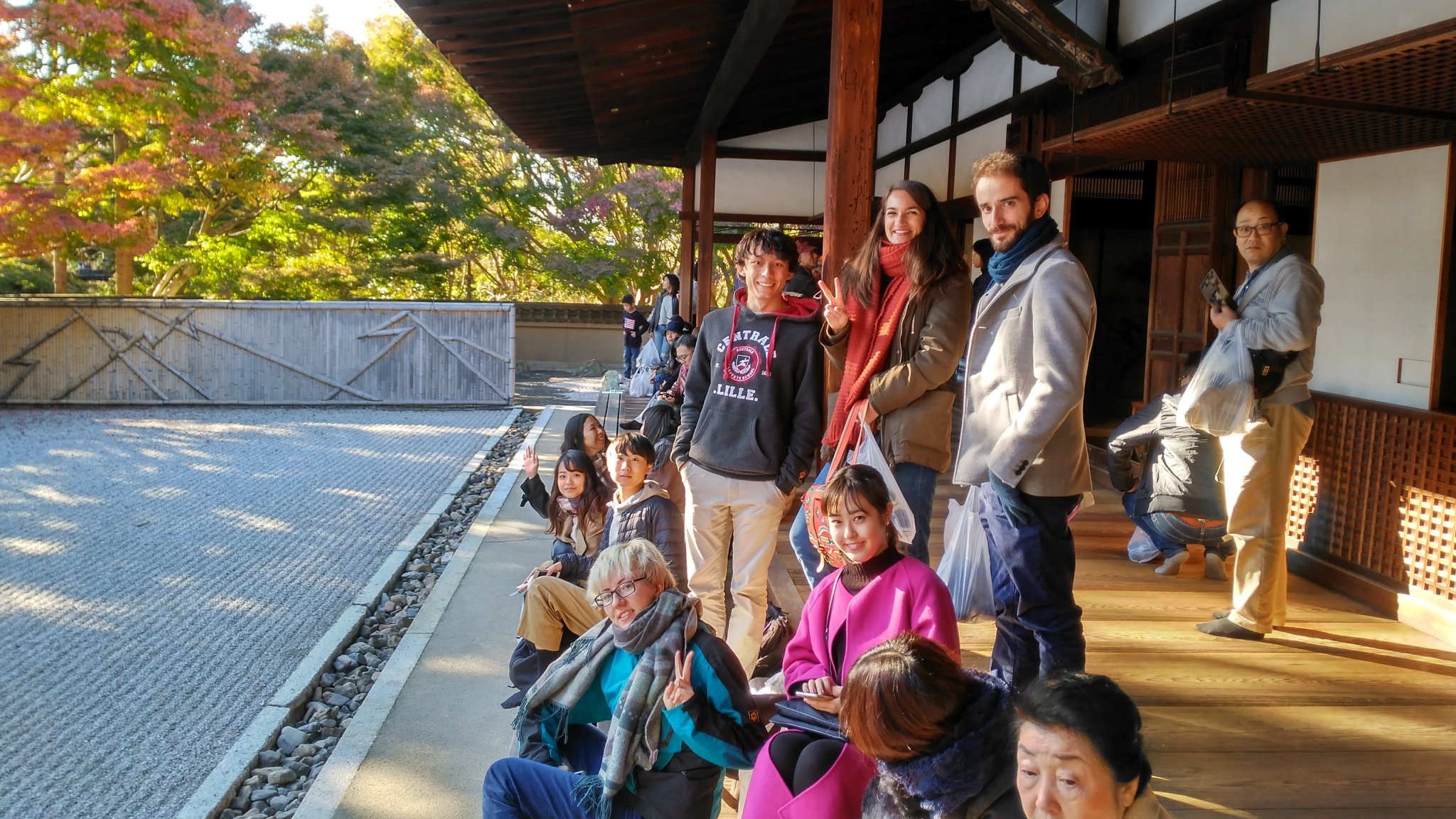
Visiting the gardens ot Tofuku-ji temple. In the photo, some of the students appreciating the Zen dry landscape garden of Ryogin-an sub-temple.
|
<到達目標/Goals,Aims>
1. To introduce the culture of Japanese gardens, its main philosophical values,styles, aesthetics,and landscape design principles through history while developing global cultural competence and a deeper understanding of Japan.
2. To develop initiatives and group-research projects where debates and discussions can enhance communicative skills and cross cultural capabilities.
3. To implement teaching strategies based on the Constructive Learning Theory (CLT) and the development of a divergent thinking.
<DO Week期間の初回動画等の配信/The delivery of the first video, etc. during the “DO Week”>
あり/ Deliver the video
URL公開期間は終了しました。/The URL was closed.
<授業計画/Schedule>
実施時期
/Week |
授業回/Number of Lesson |
授業実施方法
/How to conduct a Lesson |
授業実施時間数
/Class Hours |
| 内容/Contents |
| 授業時間外の学習/Assignments |
第1週/Week 1
(DO Week)
|
Week 1. |
オンデマンド(動画視聴)/On-demand(watching video)
|
90 分/min |
INTRODUCTION TO THE COURSE
First Meeting, Course Outline, Study Plan, and Self-presentation.
Introduction to the study of gardens.
|
| - To prepare materials and study for next class. |
|
第2週/Week 2
|
Week 2. |
面接/Face-to-face
|
90 分/min |
Chapter 1:
THE STUDY OF GARDENS
Basic Concepts and ideas.
|
- To watch on internet one of the BBC's 10 documentaries "Around the World in 80 Gardens".
|
|
第3週/Week 3
|
Week 3. |
面接/Face-to-face
|
90 分/min |
Chapter 2:
HISTORY OF GARDENS
From its Origins to the English Garden.
|
| - To prepare materials and study for next class. |
|
第4週/Week 4
|
Week 4. |
面接/Face-to-face
|
90 分/min |
Chapter 3:
THE CHINESE GARDEN
Hunting Parks, Courtyards, and Beliefs.
|
- To prepare materials and study for next class.
|
|
第5週/Week 5
|
Week 5. |
面接/Face-to-face
|
90 分/min |
Chapter 4:
ORIGINS OF JAPANESE GARDEN
Asuka Renaissance and the Gardens of Nara Period (552-794 AD).
|
- To prepare materials and study for next class.
|
|
第6週/Week 6
|
Week 6. |
面接/Face-to-face
|
90 分/min |
Chapter 5:
REINVENTING AESTHETICS
Gardens of the Heian Period (794-1185).
|
| - To prepare materials and study for next class. |
|
第7週/Week 7
|
Week 7. |
面接/Face-to-face
|
90 分/min |
Chapter 6:
THE ZEN INFLUENCE
The Gardens of Kamakura and Muromachi Periods (1185-1573).
|
- To prepare materials and study for next class.
|
|
第8週/Week 8
|
Week 8. |
面接/Face-to-face
|
90 分/min |
Chapter 7:
AUSTERITY AND EXTRAVAGANCE
Gardens of the Azuchi-Momoyama Period (1573-1603).
|
- To prepare materials and study for next class.
|
|
第9週/Week 9
|
Week 9. |
面接/Face-to-face
|
90 分/min |
Chapter 8:
TRANSITION IN ISOLATION
Gardens of the Edo Period (1603-1868).
|
- To prepare materials and study for next class.
|
|
第10週/Week 10
|
Week 10. |
面接/Face-to-face
|
90 分/min |
Chapter 9:
A WORLDWIDE ATTENTION
Gardens since the Meiji Period (1868-).
|
- To prepare materials and study for next class.
|
|
第11週/Week 11
|
Week 11. |
面接/Face-to-face
|
90 分/min |
MIDDLE-TERM EVALUATION (30%)
Research Practice, Guidance and Support.
|
- To prepare materials and study for next class.
|
|
第12週/Week 12
|
Week 12. |
面接/Face-to-face
|
90 分/min |
PRACTICUM 1
Individual Short Report Submission (10%).
|
- To prepare materials and study for next class.
|
|
第13週/Week 13
|
Week 13. |
面接/Face-to-face
|
90 分/min |
PRACTICUM 2
Group Oral Presentation (20%).
|
| - To prepare materials and study for next class. |
|
第14週/Week 14
|
Week 14. |
面接/Face-to-face
|
90 分/min |
PRACTICUM 3
Group Oral Presentation (time available for possible continuation of oral presentations from the previous week).
Research Practice, Guidance and Support.
|
| - To prepare materials and study for next class. |
|
授業期間終了後/After the Class Period
|
Week 15. |
オンデマンド(動画視聴)/On-demand(watching video)
|
90 分/min |
PRACTICUM 4
Final Group Research Report Submission (20%).
In-Class evaluation, final observations and recommendation.
|
- To Recognize from now on the characteristics within a varied range of Japanese garden.
|
<授業実施時間数/Class Hours>
| 授業実施方法/How to Conduct a Lesson |
授業実施時間数/ Class Hours |
| 面接/Face-to-face |
1170 分/min |
| オンデマンド(動画視聴)/On-demand(watching video) |
180 分/min |
| オンデマンド(授業内課題)/On-demand(assignment in class) |
0 分/min |
| リアルタイム配信/Real-time online |
0 分/min |
| その他/Others |
0 分/min |
| 総合計/Total Amount of Class Hours |
1350 分/min |
アクティブラーニング/Active Learning
発見学習 / Discovery Learning, 調査学習 / Research Based Learning, ディスカッション / Discussion, ディベート / Debate, プレゼンテーション / Presentation
使用システム/System Tools
使用しない / None
<成績評価基準/Evaluation Criteria>
|
Weekly evaluation (attendance and participation).
|
15%
|
Attendance to class based on the active participation of the student, involvement in group challenges and collaboration under the evaluation process.
|
|
Individual short report submission.
|
15%
|
A contribution that students have to make by proposing ideas, comments, opinions or keeping a mere conversation on the topics studied.
|
|
Middle-term evaluation.
|
30%
|
Individual Evaluation: To evaluate the understanding of contents covered in class. Also, based on how the student expresses ideas subject to evaluation. There is one (1) middle-term evaluation during the semester which will be held at the end of the second session of the course (on the 11th week). The middle-term evaluation has 30% of total evaluation.
|
Group oral presentation.
|
20%
|
Group Evaluation: This is the student's group-research oral presentation that will be held in the class of the weeks 13th and 14th.
|
|
Group final research report submission.
|
20%
|
Whole-class Evaluation: This is the submission of the group-research report in the class of the week 15th. After a review and recommendation made by the professor, the whole-class research report (all groups included) will be finally submitted on the 15th week (last day of class). The report is a single document elaborated by the entire class. This is the final stage of the Practicum where the students have more than 10 weeks to complete this assignment.
|
<テキスト/Textbook>
There is no textbook.
Documents and materials for study are in English and prepared by the professor.
<参考文献/Reference Book>
<連絡方法 / Contact method>
科目担当者への連絡方法/Contact method from student to instructor
授業内で指示する (contact in classroom)
科目担当者からの連絡方法/Contact method from instructor to students
授業内で指示する (contact in classroom)
<備考/Remarks>
Classes will be conducted face-to-face in the classroom.
|

